The year-end close is a key moment for tourism businesses to review their income and expenses before filing their tax return. Ideally, that review should be planned in the last few months of the year, especially as regards related-party transactions and transfer pricing.
Intra-group services in the tourism sector
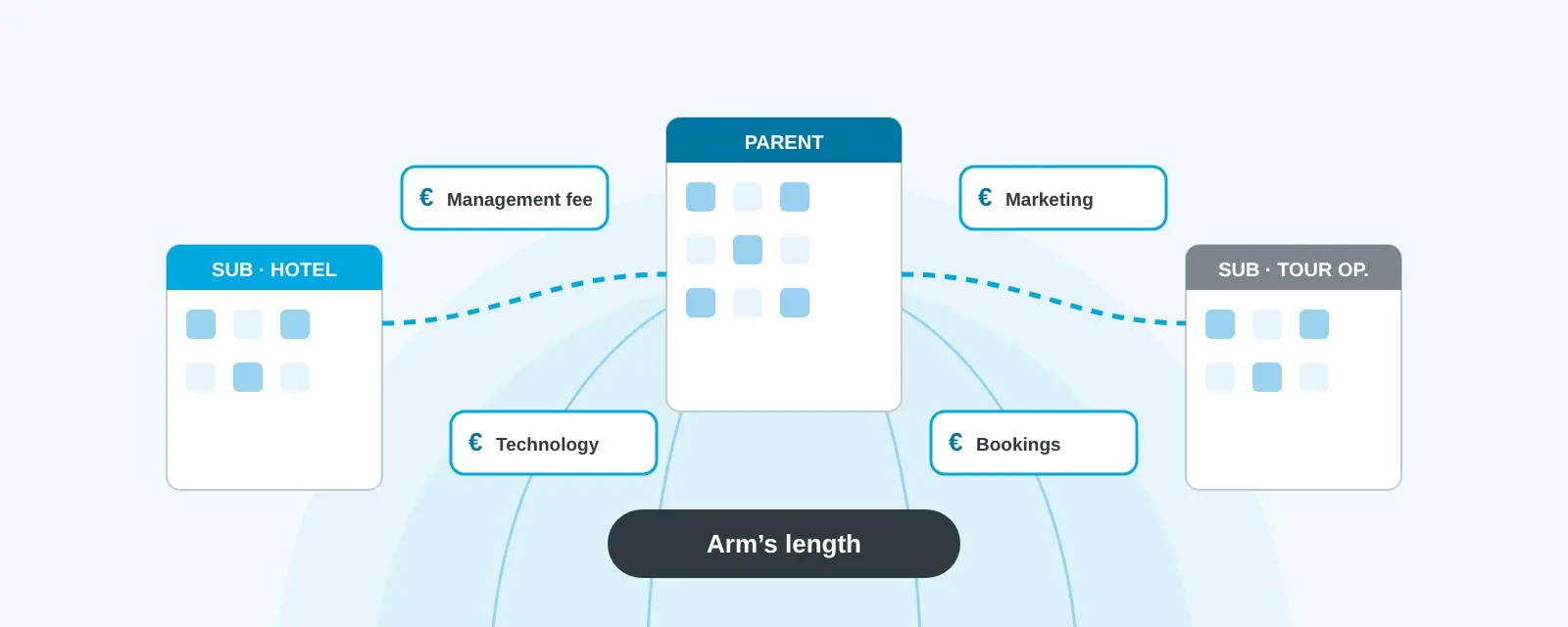
One of the most relevant areas is services provided by entities within the same group: management fees, marketing or the management of technology systems, among others. They are in the tax authorities’ sights because of their complexity and their impact on transfer pricing.
Recent court decisions have established criteria on their deductibility that affect current tax management and may call into question transfer pricing policies applied in previous years.
Requirements for deducting an intra-group service
The guiding principle is market value: transactions between related entities must reflect conditions comparable to those that independent parties would agree. For tourism businesses operating in several jurisdictions, applying this is not always straightforward.
In addition, Spanish rules require intra-group services to:
- Have actually been provided.
- Specify their nature and the methods for allocating the costs.
- Generate an advantage or benefit for the recipient.
- Be correctly recorded in the accounts and allocated.
- Be linked to the income generated.
For a hotel chain or a large tour operator, any destination promotion or booking management service must be documented and linked to the value it generates for the Spanish operation. Transfer pricing documentation makes it possible to show that the arm’s length principle is met and is the best tool for avoiding disputes with the tax authorities.
The importance of intercompany agreements
Recent judgments point out that the lack of clear contracts for intra-group services considerably increases the burden of proof needed to justify their deductibility. This is especially relevant where the services are provided by an international parent company: without contracts describing the nature, scope and benefit of the services, the tax authorities may disallow the expense.
It is therefore advisable to put in place detailed contracts for all intra-group services and to back them up with invoices and records of performance showing that the services were actually provided.
Shareholder costs in tourism businesses
The OECD Transfer Pricing Guidelines identify “shareholder costs”: expenses of the parent company that bring no direct benefit to subsidiaries, such as global market studies or corporate strategies unrelated to local operations.
The courts have stressed that this concept must be applied restrictively. If a service is relevant to the subsidiary’s local business (destination analysis or regional marketing campaigns, for example), it must be treated as a deductible intra-group service and not as a shareholder cost.
Services from foreign parent companies: local market value
In tourism, it is common for the parent company to centralise functions such as accounting, technology development or booking management. The deductibility of those expenses may be challenged if it is not in line with the market value in the country where the subsidiary operates.
A recent judgment held that expenses charged to a branch in Spain must correspond to the cost those services would have on the Spanish market. If the parent company of a hotel chain charges for accounting services provided in a country with higher salaries, the tax authorities may limit the deduction to a reasonable level for Spain. This approach sits uneasily with the global nature of the sector, but it means you must document the link between the services provided and the income generated in Spain.
Correlation between expenses and income
You also need to show the correlation between expenses and income. Any expense, such as destination promotion or booking management, must be linked to the income earned in Spain. Without contracts, invoices or transfer pricing documentation, the expense may be disallowed even if the related income has been recorded in the accounts.
What to do before the year-end close
- Put in place detailed contracts for all intra-group services, setting out their nature, their benefit and the allocation method.
- Keep supporting documentation: invoices, delivery notes and records of the services provided.
- Prepare transfer pricing documentation, which, as well as being a legal obligation, is the basis for justifying the policy applied and reducing the risk of adjustments and penalties.
- Carry out regular internal reviews of transfer pricing policies and compliance with them.
- Consider adjustments to the tax base where there are doubts about the deductibility of certain expenses, as a prudent measure against contingencies.
Conclusion
Managing intra-group services is central in an increasingly demanding tax environment. Anticipating the criteria of the tax authorities and the courts with a rigorous approach reduces risk and brings stability to the business.
Frequently asked questions
When is an intra-group service deductible?
When it has actually been provided, benefits the recipient, is valued at market price, is correctly recorded in the accounts and is linked to income. Contracts and transfer pricing documentation are the main evidence.
What are shareholder costs?
They are expenses of the parent company that benefit the group in its capacity as shareholder rather than a specific subsidiary, such as global corporate strategies. They cannot be recharged to subsidiaries, but the courts apply the concept restrictively.
Is a contract mandatory for intra-group services?
Without a contract, the burden of proof to justify the deduction increases considerably and the tax authorities may disallow the expense. Putting one in place is strongly recommended.
This article is for information only and does not constitute legal or tax advice.