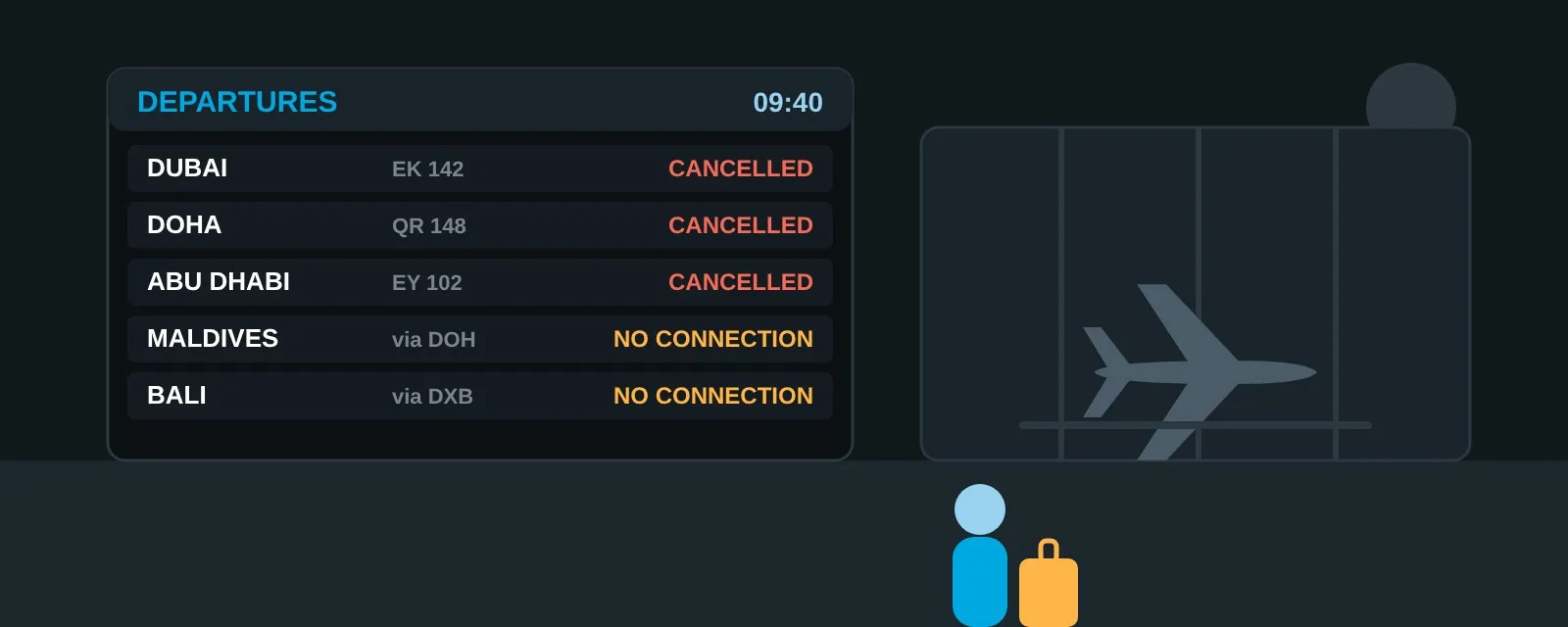
Since 28 February 2026, the airspace of at least eight Middle Eastern countries has been fully or partially closed because of the escalating conflict between the United States, Israel and Iran. More than 12,000 flights have been cancelled. The airports of Dubai, Doha, Abu Dhabi and Manama have suspended or drastically reduced their operations, and Emirates has suspended all its scheduled flights until at least 4 March.
The impact is not limited to trips to the conflict zone. The Dubai, Doha and Abu Dhabi hubs channel millions of passengers a year to Southeast Asia, Oceania, East Africa and the Indian subcontinent. Travellers with packages to Bali, Vietnam, the Maldives, Australia or Thailand who relied on those connections find themselves with no outbound flight, no return flight, or neither.
For tour operators, wholesalers and travel agencies, the question is specific: what obligations do I have towards the traveller? What can I require from my suppliers? And how do I handle this without repeating the mistakes of COVID?
We look at three practical scenarios under Spanish law, which transposes Directive (EU) 2015/2302 on package travel in Royal Legislative Decree 1/2007 (Book Four, as worded by Royal Decree-law 23/2018).
The legal framework: unavoidable and extraordinary circumstances
Package travel law does not use the traditional concept of force majeure in Article 1105 of the Spanish Civil Code. Article 151(1)(j) of Royal Legislative Decree 1/2007 defines its own concept, unavoidable and extraordinary circumstances: a situation beyond the control of the party relying on it, the consequences of which could not have been avoided even if all reasonable measures had been taken.
The definition comes from Directive 2015/2302 and is broader than traditional force majeure. It does not require absolute unforeseeability, but two things: that the event is beyond the party’s control and that its consequences are unavoidable despite having acted with due diligence.
An active armed conflict with mass airspace closures, attacks on civilian airports, widespread flight cancellations and government advice against travel fits this definition beyond any doubt. The Spanish Ministry of Foreign Affairs recommends keeping informed and warns that UAE airspace may close without notice. The UK FCDO and the US Department of State advise against travel to the UAE, Qatar, Kuwait and Bahrain, and advise against all travel to Iran and Israel.
Unlike force majeure clauses in B2B contracts, whose outcome depends on how each one is drafted, in package travel the protection is statutory, mandatory and does not depend on the contract.
Scenario 1: trips departing in the next 48 hours
Take a seven-day package to Dubai departing in 48 hours. The main Western governments advise against travel to the UAE, the airport is operating only priority repatriation flights and the airspace remains closed or only intermittently open. It is practically inevitable that the trip cannot go ahead without being significantly affected.
The traveller’s rights
Under Article 160(2) of Royal Legislative Decree 1/2007, where unavoidable and extraordinary circumstances occur at the destination or in its immediate vicinity and significantly affect the performance of the package or the carriage of passengers to the destination, the traveller can terminate the contract without a penalty. They are entitled to a full refund of what they have paid, but not to additional compensation.
Article 160(2) of Royal Legislative Decree 1/2007: termination without a penalty due to unavoidable and extraordinary circumstances, with a full refund within 14 days and no additional compensation.
The organiser’s obligations
The organiser must inform the traveller without delay, without waiting to be contacted. If the traveller terminates, the refund must be made without undue delay and, at the latest, within 14 calendar days.
Alternatives worth offering
Before cancelling, it is worth proposing to reschedule the trip or change the destination, which is usually better for both parties. But the traveller is not obliged to accept. If they choose to terminate, the organiser must comply: offering vouchers or rescheduling as the only option, with no real possibility of a refund, breaches the law.
Scenario 2: trips departing in more than 48 hours
This is the most complex scenario, because nobody knows how long the conflict will last. The organiser has to decide whether there is no longer a reasonable chance of the trip going ahead normally or whether it is too early to cancel.
There is no fixed deadline
The law does not set a specific number of days’ notice. What it requires is a reasonable assessment, based on the information available, of whether there is still a real chance of the trip going ahead without being significantly affected.
Today it seems reasonable to cancel, or to allow cancellation without a penalty for, trips departing in the next seven days to affected destinations. But the assessment may change: if the conflict escalates, seven days become fourteen; if there is a ceasefire, the horizon shortens.
Practical recommendation
Set an internal criterion you can revise: cancel without a penalty all trips departing in the next X days to destinations affected directly or indirectly. Review it every 48 hours and document each decision and the information it is based on.
Scenario 3: travellers stranded at destination or in transit
It is already happening: there are travellers stranded in the UAE, in transit in Doha or in Southeast Asia with no return flight because their connection went through a closed hub. The Spanish Embassy in Abu Dhabi has set up assistance channels and coordination with the airlines.
Duty to provide assistance
Article 163 of Royal Legislative Decree 1/2007 requires the organiser to provide appropriate assistance without delay to a traveller in difficulty: information on health services, local authorities and consular assistance, and help to communicate and to find alternative travel arrangements.
Accommodation if return is impossible
If return is impossible because of unavoidable and extraordinary circumstances, the organiser bears the cost of necessary accommodation for up to three nights per traveller, of an equivalent category where possible (Article 161(7)). That limit does not apply to people with disabilities or reduced mobility and those accompanying them, pregnant women, unaccompanied minors and people in need of specific medical assistance, provided they have notified their needs at least 48 hours before the start of the trip (Article 161(8)).
The nuance of Regulation 261/2004
The airline’s obligations coexist with the organiser’s. Regulation (EC) 261/2004 requires the airline to provide assistance and offer re-routing, without the three-night limit. But it only applies to flights departing from the EU, or arriving in the EU operated by an EU carrier. A Spanish traveller in Indonesia returning via Doha on Qatar Airways falls outside the Regulation, and the entire obligation falls on the organiser.
Repatriation
The organiser must repatriate the traveller on equivalent transport, without delay and at no extra cost: other airlines, alternative routes or additional stopovers. It cannot refer the traveller to the airline and wash its hands of the matter. Liability towards the consumer lies with the organiser, which can then seek redress from the suppliers that contributed to the problem (Article 161(1)).
The problem with the B2B chain
The law requires the organiser to refund the traveller within 14 days, but its suppliers (airlines, hotels, inbound operators) have no such obligation. It happened in 2020: organisers refunded travellers while airlines took months to pay back, and the gap was funded from the organiser’s balance sheet.
Royal Decree-law 11/2020 temporarily allowed vouchers as an alternative to a refund. That measure is no longer in force: if the traveller wants their money, they are entitled to receive it within 14 days.
If you have not renegotiated your supplier contracts since 2020 to include refund mechanisms aligned with that deadline, you have the same liquidity problem as back then.
Package travel, stand-alone service or linked travel arrangement
All this protection applies only to package travel: at least two travel services sold at an inclusive price. A flight and a hotel bought separately are not a package. In that case, the traveller is governed by each supplier’s terms and, for air transport, by Regulation 261/2004 where it falls within its scope, with much less protection.
Linked travel arrangements have an intermediate regime, centred on insolvency protection, without the full obligations of the organiser.
What to do now
- Identify all affected packages, including those that depend on connections through closed hubs. A trip to the Maldives with a stopover in Doha is just as affected as a direct trip to Dubai.
- Proactively tell travellers about their options and deadlines, and document all communications.
- Ask suppliers for written confirmation of their cancellation and refund policy.
- Review your B2B contracts: force majeure clauses and refund mechanisms compatible with the 14-day statutory deadline.
- Assess your liquidity. If you have a significant volume of affected packages, run the numbers now.
Frequently asked questions
Can I charge a penalty if it is the connection, not the destination, that is affected?
No, if the cancellation of the connection significantly affects the performance of the package. The law refers to circumstances affecting the carriage of passengers to the destination, so the traveller can terminate without a penalty.
Can a stranded traveller demand a higher-category hotel?
No. The law refers to necessary accommodation, of an equivalent category where possible. If the package included a four-star hotel, the emergency accommodation should be similar, not better.
What if I only sold accommodation, without transport?
It is not a package and Book Four of Royal Legislative Decree 1/2007 (Articles 150 to 165) does not apply. You are governed by your terms and conditions and general consumer protection law.
Does the customer’s travel insurance release the organiser from its obligations?
No. The traveller can claim first against the organiser or first against the insurer. If the insurer pays, it can be subrogated and then claim against the organiser.
Sources
This article is for information only and does not constitute legal or tax advice.