Two pieces of legislation are going to change how agencies, OTAs and TravelTech companies sell to and look after their customers: the new Package Travel Directive and Customer Service Law 10/2025. They have different timetables, and it is worth being clear on both.
When does the new Package Travel Directive apply?
| Date | Milestone |
|---|---|
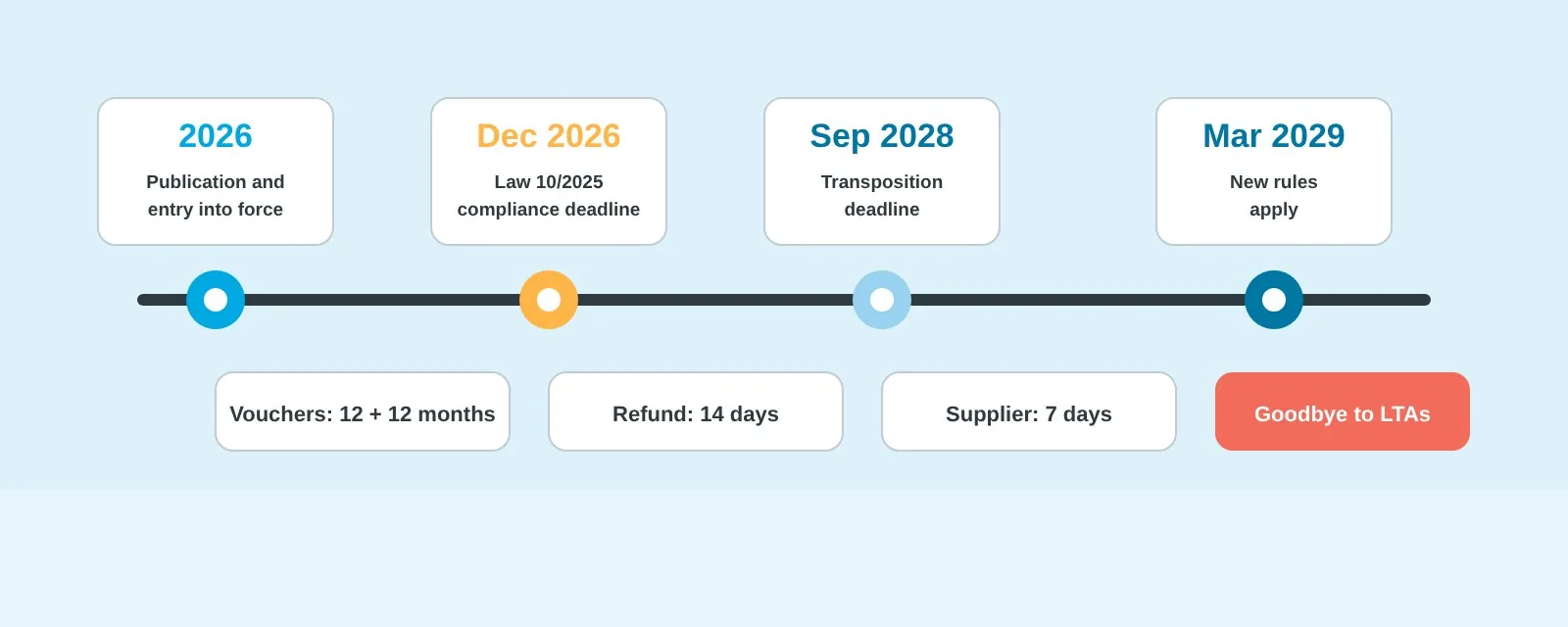
| 8 May 2026 | Publication of Directive (EU) 2026/1024 in the Official Journal of the EU |
| 20 days later | Entry into force of the Directive |
| 31 July 2026 | End of the prior public consultation on Spain’s draft transposition bill |
| 29 September 2028 | Transposition deadline for Member States |
| 29 March 2029 | New national rules apply |
Until 29 March 2029 the current rules continue to apply, including those on linked travel arrangements.
What changes with Directive (EU) 2026/1024?
Linked travel arrangements disappear
The Directive abolishes this concept. Combinations that are linked travel arrangements today will have to be assessed against the new definition of a package.
The definition of a package is broadened
There will be a package, among other cases, when a trader passes the traveller’s details (name, payment details, email or telephone) to another trader and the second contract is concluded within 24 hours of confirmation of the first booking. In addition, the threshold for “other tourist services” becomes 25% of the value of the combination.
You must give notice when a combination is not a package
If you invite the traveller to book an additional service, you must inform them at that moment, clearly and prominently, that it is not a package. If you do not, and the traveller pays for the second service at the same point of sale within 24 hours, the combination is treated as a package and you are the organiser.
Clear rules on vouchers
Vouchers will be voluntary and their value may not be lower than the refund. The traveller must expressly accept the voucher and first receive the information on a durable medium. It is valid for a maximum of 12 months, extendable once for a further 12 if both parties agree. If it expires unused, the refund must be paid within 14 days.
Refunds within 14 days and 7 days for suppliers
The organiser must refund within 14 days of termination, without the traveller having to ask. And the supplier of a cancelled or unperformed service must repay the organiser within 7 days. This responds to the liquidity problem organisers faced in 2020.
Cancellation due to unavoidable and extraordinary circumstances
The traveller will be able to cancel without penalty when it is reasonably foreseeable that the trip will be significantly affected, without waiting for the harm to occur. Official advice against travel will carry significant evidential weight, although it will not be essential.
Deadlines for responding to complaints
The organiser must acknowledge receipt of a complaint within 7 days and give a reasoned response within 60 days. Member States may set shorter deadlines.
Stronger insolvency protection
The guarantee must cover all travellers’ payments, including those already entitled to a refund or a voucher, and be sufficient at all times, taking into account peaks in payments received and sales growth.
What does Spain have to decide in the transposition?
The Directive leaves Member States room for manoeuvre on points such as the deposits that can be taken at booking and the deadlines for responding to complaints. The prior public consultation on the draft bill, opened by the Directorate-General for Consumer Affairs, closed on 31 July 2026 and proposes a law amending the consolidated text of the General Law for the Protection of Consumers and Users.
What does Customer Service Law 10/2025 require?
Law 10/2025 of 26 December has been in force since 28 December 2025 and allows twelve months to adapt. Its main obligations are:
- Response time: a maximum of 15 working days to resolve enquiries, complaints and claims, unless sector-specific rules set a different period.
- Human assistance: customers can ask to be dealt with by a person, and 95% of those requests must be answered, on average, in under three minutes. An automated answering service cannot be the only channel.
- Cost and channels: a call cannot cost more than a standard call, and businesses must accept at least the channel through which the relationship began, as well as telephone, post and an electronic channel.
- Assessment: an annual quality assessment system, documented and published on the website, audited by an accredited body.
Is an OTA bound by Law 10/2025?
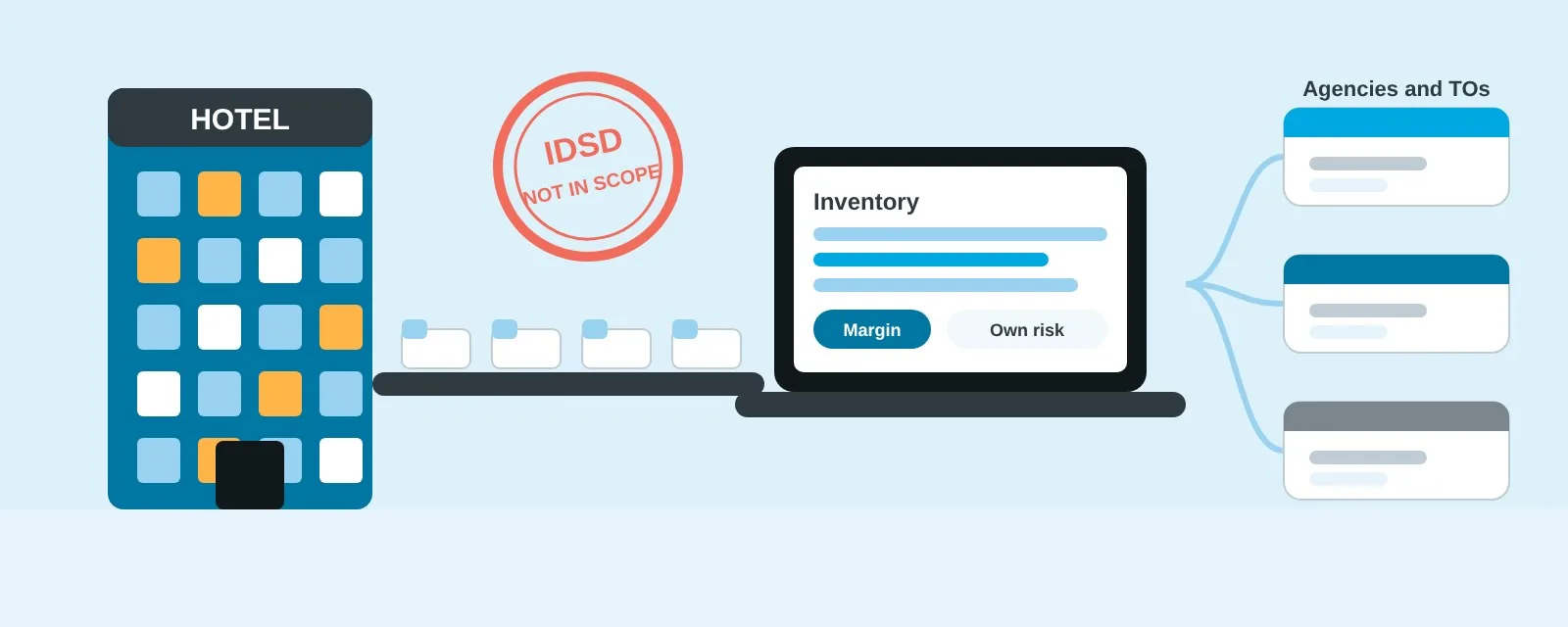
It depends on its size. The law always applies to providers of basic services, including air, rail, sea and road transport companies. For other consumer-facing businesses, such as OTAs, agencies or hotels, it applies if, at group level, they have at least 250 employees, turnover above €50 million or a balance sheet total above €43 million. Outsourcing customer service does not remove the obligation.
What should you do now?
- Check whether your company falls within the scope of Law 10/2025 and adapt your customer service before the deadline ends.
- Map your booking flows to identify combinations that will be packages under the new definition.
- Review your supplier contracts to include refunds within 7 days.
- Prepare the terms and the voucher and complaints policies that the new rules will require.
Frequently asked questions
When does the new Package Travel Directive come into force?
Directive (EU) 2026/1024 was published on 8 May 2026 and came into force 20 days later, but its rules will apply from 29 March 2029, once transposed. Until then the current rules remain in force.
What is the difference between a package and a linked travel arrangement, and what changes with the new Directive?
Today, with a package the organiser is liable for all the services, whereas a linked travel arrangement carries less protection, focused on insolvency. The new Directive abolishes linked travel arrangements and broadens the definition of a package.
From when must businesses comply with Law 10/2025?
It has been in force since 28 December 2025 and allows twelve months to adapt.
How long do I have to respond to a complaint under Law 10/2025?
A maximum of 15 working days, unless sector-specific rules set a different period.
Sources
This article is for information only and does not constitute legal or tax advice.